Electrolytes and Fasting: Why They Matter
Headaches and fatigue during a fast are often an electrolyte problem, not a hunger one — and the fix carries its own risk if you get it wrong.
The headache, the flatness and the cramp on day two of a fast are usually described as your body detoxing. They are more often electrolytes. That is a better explanation, because it is one you can act on — carefully, because the correction has its own failure mode.
What actually happens when you stop eating
Insulin falls when food stops. One of insulin’s jobs is telling the kidney to hold on to sodium, so when it drops, the kidney lets more sodium and water go. That is why the first days of a fast produce quick weight loss and frequent urination, and why the symptoms that follow — headache, fatigue, light-headedness, cramp — look like dehydration.
The usual response is to drink more water. On its own, that makes the sodium problem worse rather than better.
Hyponatremia is the most common electrolyte disorder in hospitalized patients.
The one to take seriously
Hyponatraemia — serum sodium below 135 mEq/L — is the most common electrolyte disorder in hospitalised patients, which tells you how easily sodium is disturbed. Fasting while drinking large volumes of plain water is a straightforward way to dilute it.
There is a second, less obvious hazard: correcting it. Rapid correction of chronic hyponatraemia is associated with osmotic demyelination, permanent neurological damage. You will not cause that with a pinch of salt in a glass of water, and it is not a reason to avoid sodium. It is a reason that anyone who is genuinely, symptomatically low belongs in front of a doctor rather than reaching for a stronger electrolyte mix.
The three that matter, in order
- Sodium. The one you lose first and fastest. Most fasting headaches and fatigue trace here.
- Potassium. Nerve and muscle function; the usual source of cramp complaints.
- Magnesium. Involved in muscle relaxation and sleep, and easily depleted alongside the others.
Note what is absent: there is no toxin in this list. The symptoms attributed to toxins leaving the body are, in the main, these three moving.
Scaling the response to the fast
Under 24 hours: do essentially nothing. Eat normally either side, drink to thirst. A 16:8 window does not create an electrolyte problem, and taking supplements to solve one you do not have is its own small risk.
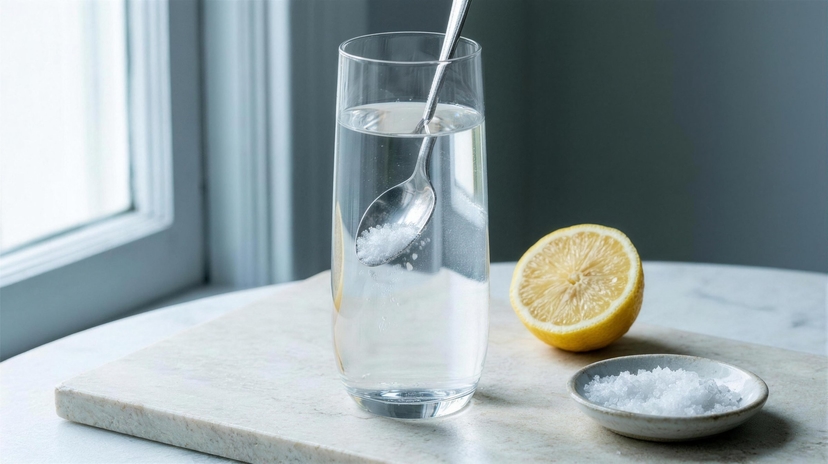
24 to 72 hours: a modest amount of sodium — a pinch of salt in water — is where most people notice the difference. Drink to thirst rather than to a target.
Beyond 72 hours: this belongs under medical supervision, and electrolytes are the reason why, not an incidental detail.
The part people miss: breaking the fast
The most dangerous moment of a long fast is not the fasting. It is the first meal.
Reintroducing nutrition after prolonged starvation drives fluid and electrolyte shifts, and the hallmark is hypophosphataemia — a fall in phosphate — alongside magnesium, potassium and thiamine. This is refeeding syndrome, and it is why long fasts are ended slowly and under supervision rather than with a large celebratory meal.
When not to improvise
If you have high blood pressure, kidney disease, heart failure, or take diuretics, lithium or blood-pressure medication, do not add sodium or an electrolyte product on your own judgement. For these conditions the correct amount is prescribed, not estimated.
The bottom line
Most fasting misery is sodium, and on anything under a day it needs no intervention at all. On longer fasts a small amount of salt helps, plain water in volume hurts, and the highest-risk moment is the meal that ends it. Electrolytes are the right explanation — which is exactly why they deserve care rather than enthusiasm.
References
Each source is listed against the claim it supports, so you can check the pairing rather than take the list on trust.
-
1. Supports: “Hyponatraemia is a serum sodium concentration below 135 mEq/L and the most common electrolyte disorder in hospitalised patients; rapid correction of chronic hyponatraemia is associated with osmotic demyelination.”
Hyponatremia — Rout P, Afzal M . StatPearls Publishing , last updated 2026-06-19.
-
2. Supports: “Reintroducing nutrition after prolonged starvation causes fluid and electrolyte shifts, with hypophosphataemia the hallmark alongside falls in magnesium, potassium and thiamine.”
Refeeding Syndrome — Persaud-Sharma D, Saha S, Trippensee AW . StatPearls Publishing , last updated 2022-11-07.
Written by
Health journalist covering fasting, detox protocols, supplements and recovery, with a bias towards saying what the evidence does not show.