Magnesium Types Explained: Which One Do You Need?
Glycinate, citrate, oxide, malate — the forms differ far less than the marketing implies, with one real exception the evidence supports.
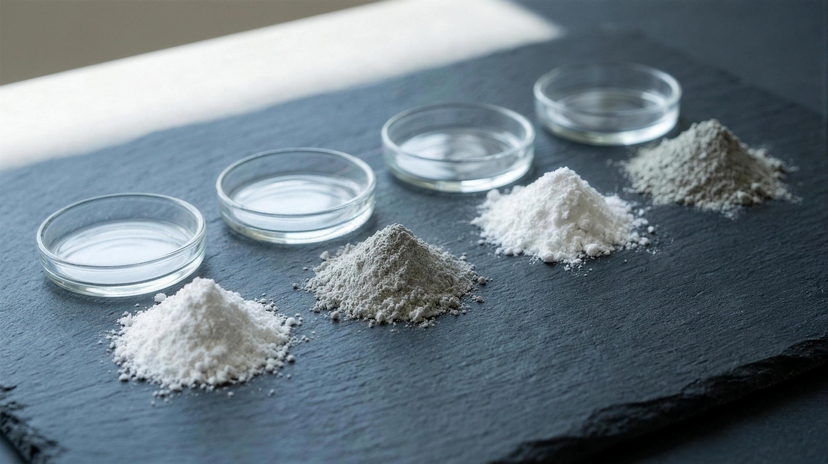
The magnesium aisle is a masterclass in making a cheap mineral sound like a range of different products. Glycinate, citrate, malate, taurate, threonate, oxide, chloride, orotate — each with a promise attached. The evidence supports far fewer distinctions than the labels do.
Start with the amount, not the form
In the UK the recommended intake is 300 mg a day for men and 270 mg a day for women aged 19 to 64. Food contributes: leafy greens, nuts, seeds, legumes, wholegrains and dark chocolate are all meaningful sources.
That matters because form is a second-order question. A well-absorbed magnesium at an irrelevant dose still does nothing, and most people asking which type to buy would be better served by asking how much they are already getting.

All magnesium dietary supplements can maintain physiological levels in healthy people without prior deficit, although this cannot be assured in older people or those with illnesses or previous subphysiological levels.
The one distinction that holds up
Magnesium oxide is genuinely different, and not in a good way. In a controlled comparison it was virtually insoluble in water and only 43% soluble in simulated peak acid secretion, while magnesium citrate dissolved readily and produced far more urinary magnesium after an equivalent dose — the measure of how much actually got in.
A systematic review of 14 studies reaches the same broad conclusion: organic forms are better absorbed than inorganic ones, and the proportion absorbed falls as the dose rises.
Oxide is also the cheapest, which is why it fills supermarket shelves and multivitamins. If absorption is your aim, it is the one form worth avoiding.
The distinctions that do not hold up
Here the honest answer is unsatisfying. There is no good head-to-head trial establishing that glycinate beats citrate for sleep, or malate for energy, or threonate for cognition, at doses people actually take. The systematic review’s authors were explicit that the study designs differ too much to rank the salts confidently.
So treat the following as reasonable practical guidance rather than evidence:
- Citrate — well absorbed, and its laxative tendency is useful if you are constipated and a nuisance if you are not.
- Glycinate — gentle on the stomach, which is a real advantage and the main reason it is a sensible default.
- Malate, taurate, orotate — organic, so presumably absorbed comparably. The specific claims attached to each are ahead of the evidence.
- L-threonate — marketed for the brain on early and largely preliminary work. It is also the most expensive by a distance.
- Oxide — poorly soluble, mostly useful as a laxative.
What the review actually concludes
The line worth carrying away is this: all magnesium supplements maintained physiological levels in healthy people without a prior deficit — but that could not be assured in older people, people with illnesses, or anyone already running low.
Which inverts the usual shopping question. If you are healthy and topping up, the form barely matters. If you are actually depleted, elderly or unwell, the form is not the issue either — the issue is that you need proper assessment rather than a better label.
Dose and caution
More than 400 mg a day from supplements can cause diarrhoea; at or below that, harm is unlikely in healthy people. That threshold applies to supplements, not to food.
Magnesium is cleared by the kidneys, so reduced kidney function turns a harmless surplus into an accumulating one — anyone with kidney disease needs medical advice first. Magnesium also interferes with the absorption of some antibiotics and thyroid medication, which is usually managed by spacing the doses a few hours apart. A pharmacist can settle this in a minute.
The bottom line
Skip oxide, pick any reasonably priced organic form, keep supplements at or under 400 mg, and do not pay a premium for a claim no trial has tested. The interesting variable is your total intake, and most of that comes from dinner.
References
Each source is listed against the claim it supports, so you can check the pairing rather than take the list on trust.
-
1. Supports: “UK recommended magnesium intake is 300 mg a day for men and 270 mg a day for women aged 19 to 64; more than 400 mg from supplements can cause diarrhoea, and 400 mg or less a day from supplements is unlikely to cause harm.”
Vitamins and minerals — Others . NHS .
-
2. Supports: “Magnesium oxide was virtually insoluble in water and only 43% soluble in simulated peak acid secretion, while magnesium citrate was more soluble and more bioavailable, with markedly higher urinary magnesium after an equivalent dose.”
Magnesium bioavailability from magnesium citrate and magnesium oxide — Lindberg JS, Zobitz MM, Poindexter JR, Pak CY . Journal of the American College of Nutrition, 1990 .
-
3. Supports: “Across 14 selected studies, organic magnesium forms were better absorbed than inorganic ones and absorption fell as the dose rose, but all magnesium supplements maintained physiological levels in healthy people without a prior deficit.”
Bioavailability of magnesium food supplements: A systematic review — Pardo MR, Garicano Vilar E, San Mauro Martín I, Camina Martín MA . Nutrition, 2021 .
Written by
Health journalist covering fasting, detox protocols, supplements and recovery, with a bias towards saying what the evidence does not show.