Are Greens Powders Worth It?
The evidence for vegetables is about weight of intake — up to 800 g a day. A scoop of powder weighs about eight, and that is the whole problem.
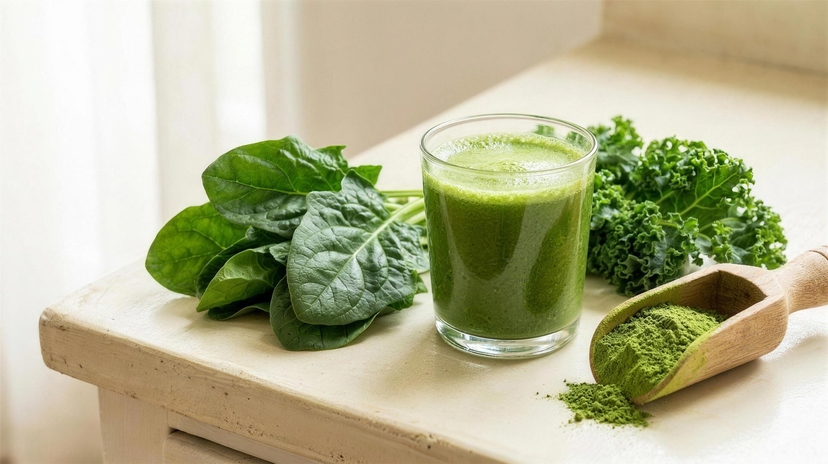
Greens powders sell an appealing trade: skip the cooking, keep the benefit. The reason it does not work is not that powders are bad. It is arithmetic.
What the vegetable evidence is actually about
The largest analysis of this question pooled 95 prospective studies and found a dose-response relationship. Each 200 g a day of fruit and vegetables was associated with a relative risk of 0.90 for all-cause mortality, and reductions continued up to 800 g a day.
The authors put a number on the stakes: an estimated 5.6 to 7.8 million premature deaths worldwide in 2013 may be attributable to intakes below 500 and 800 g a day.
Reductions in risk were observed up to 800 g/day for all outcomes except cancer (600 g/day).
Now weigh the scoop. Greens powders are typically dosed at around 8 to 12 g. Even accepting that drying removes water and concentrates some nutrients, the exposure being measured in those studies — hundreds of grams of whole plant material, several times a day, for years — is not something a scoop is a compressed version of. It is a different quantity by two orders of magnitude.
That is the whole case, and no amount of ingredient-list quality changes it.
The nutrient they replace worst
Fibre is the clearest example. Recommended intake is about 25 g a day for women and 38 g for men, against a measured average of roughly 17 g. So the typical shortfall is somewhere between 8 and 20 g a day.
A scoop of greens powder usually contributes 1 to 2 g. It patches perhaps a tenth of the gap it is bought to close — and fibre is precisely what someone eating few vegetables is missing.
There is a second loss that is harder to quantify honestly: whole plants arrive with water, structure, and a matrix that changes how quickly things are absorbed and how full you feel. Powder has none of that. I would not push this argument far, because the evidence separating “food matrix” effects from simple intake is genuinely weak — but the fibre arithmetic above does not depend on it.
Where a powder is defensible
Not nowhere. If you are travelling, working shifts, in a period where fresh food is genuinely not happening, or recovering from something that has flattened your appetite, a powder is a reasonable micronutrient top-up. That is a real use, and it is a much smaller claim than the marketing makes.
It is worth saying plainly: taking one is not harmful, and if it makes you feel you are looking after yourself, that is not nothing. It just is not the vegetables.
How to judge one, if you are buying
- Transparent dosing per ingredient. A “proprietary blend” tells you the order of ingredients and nothing about the amounts, which is usually the point.
- Check the fibre and the scoop weight on the label. Both are printed, and both are smaller than you expect.
- Discount the claims. “Detoxifying”, “alkalising” and “immune-boosting” are marketing categories, not physiological ones.
- Do the monthly arithmetic. A £40-a-month powder buys a lot of frozen spinach, and frozen vegetables count fully towards the intake the evidence measures.
The bottom line
The vegetable evidence is a dose-response curve running out to 800 g a day, and greens powders enter that curve at around ten. They are a convenience product that patches a fraction of a micronutrient gap and almost none of the fibre gap. Buy one for the week you are living out of a suitcase, not for the diet you were planning to fix.
References
Each source is listed against the claim it supports, so you can check the pairing rather than take the list on trust.
-
1. Supports: “Each 200 g/day of fruit and vegetables was associated with a relative risk of 0.90 for all-cause mortality, with reductions observed up to 800 g/day, and an estimated 5.6 to 7.8 million premature deaths worldwide in 2013 attributable to intakes below 500 and 800 g/day.”
Fruit and vegetable intake and the risk of cardiovascular disease, total cancer and all-cause mortality — a systematic review and dose-response meta-analysis of prospective studies — Aune D, Giovannucci E, Boffetta P, et al. . International Journal of Epidemiology, 2017 .
-
2. Supports: “Recommended fibre intake is about 25 g a day for women and 38 g for men, against a measured average intake of roughly 17 g.”
The Role of Dietary Fiber in Health Promotion and Disease Prevention — Daley SF, Shreenath AP . StatPearls Publishing , last updated 2025-12-01.
Written by
Health journalist covering fasting, detox protocols, supplements and recovery, with a bias towards saying what the evidence does not show.